Planets Visible Tonight: October 2026 Sky Guide
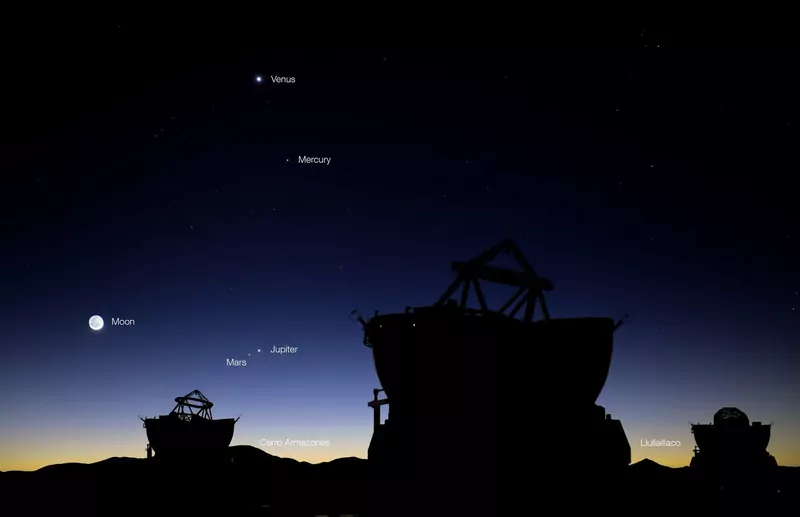
If you see a very bright "star" in the east before sunrise this month, it's Jupiter. The reddish star above it is Mars. After dark, the steady yellowish "star" that rises at sunset and climbs into the southern sky by midnight is Saturn. Venus is lost in the sunset glow, and Mercury is only easy to see from the Southern Hemisphere.
What you can see, planet by planet
| Planet | When and where | Brightness |
|---|---|---|
| Jupiter | Before dawn, low in the east and rising higher each morning. It rises about 2 a.m. in mid-October (New York 2:03, London 1:43, Sydney 3:37) | Very bright, about −1.8, brighter than every star |
| Mars | Before dawn, in the east-southeast, higher than Jupiter. It rises about 1 a.m. (New York 1:01, London 12:32, Sydney 3:02). Reddish in color | About +1.0, like a bright star |
| Saturn | All night. It rises at sunset (about 5:55 p.m. in New York and London, 6:06 p.m. in Sydney) and sets around dawn. Highest around midnight, about 51° up in New York and 40° in London | About +0.4, steady, pale yellow |
| Venus | Too close to the Sun to see from the Northern Hemisphere. From Sydney it is low in the west after sunset but sinking: about 17° up half an hour after sunset on October 8, and only 4° by October 18 | Very bright, about −4, but lost in twilight |
| Mercury | At its widest angle from the Sun on October 12. From Sydney it's visible low in the west after sunset. From New York it's only about 3° up half an hour after sunset, and from London it is below the horizon | About 0, then fading |
Rise and set times are for October 15 and are our own calculations; they shift by a few minutes a day. Your own times will differ with your location. The planets shift against the stars a little each night, but you need a few nights to notice.
Best time to look: about an hour before sunrise for Jupiter and Mars, and any time after dark for Saturn.
What's coming up
| Date | What to look for |
|---|---|
| Oct 4 (past) | Saturn at opposition: closest and brightest of the year, up all night |
| Oct 10 | New moon at 15:50 UTC, so the skies are darkest this week |
| Oct 11–12 | Mars crosses the Beehive Cluster in the hours before dawn (see below) |
| Oct 12 | Mercury at greatest elongation east of the Sun (best seen from the Southern Hemisphere) |
| Oct 21–22 | Orionid meteor shower peaks. Look after the Moon sets, at about 3 a.m. |
| Oct 24 | Venus passes between the Earth and the Sun and returns to the morning sky in November |
| Oct 25 | Clocks go back in the UK and Europe, so morning events happen an hour earlier on the clock (dates) |
| Oct 26 | Full moon, the Hunter's Moon |
| Nov 16 | Mars and Jupiter just 1.2° apart, their closest meeting |
Mars in the Beehive, October 11 and 12
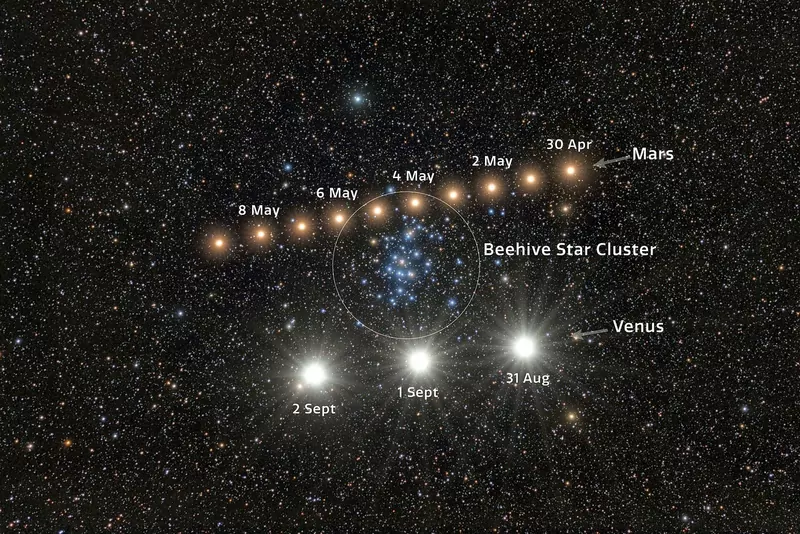
Mars moves in front of the Beehive Cluster (M44, also called Praesepe) in the constellation Cancer. On the mornings of October 11 and 12 the planet appears to sit inside the cluster, which is about 600 light-years away. Our calculation puts Mars just 0.2 degrees from the cluster's center at 04:00 UTC on October 11, and 0.3 degrees at 04:00 UTC on October 12. The BBC Sky at Night Magazine says Mars makes a run across the core between October 10 and 12.
How to see it: Mars rises around 1 a.m. and is well up in the east-southeast before dawn. The cluster is a faint smudge to the naked eye under a dark sky, and binoculars show it as a scatter of stars with orange Mars among them. The Moon is new on October 10, so it won't wash the view out.
Mars and Jupiter are getting closer
| Date | Gap between Mars and Jupiter |
|---|---|
| Oct 8 | 14.9° |
| Oct 15 | 12.2° |
| Oct 22 | 9.4° |
| Oct 29 | 6.8° |
| Nov 5 | 4.2° |
| Nov 16 | 1.2° (their closest meeting) |
For scale, your fist held at arm's length covers about 10 degrees. The November 16 date and gap match the one in BBC Sky at Night Magazine.
How to tell a planet from a star
- Planets shine steadily. Stars twinkle more, especially near the horizon.
- Planets don't sit in the star patterns. Compare a planet's position with nearby stars over a few nights, and you'll see it slowly drift.
- Color helps. Mars is orange or red, Saturn pale yellow, Jupiter bright white.
- A free sky map settles it. Point a phone app at the sky, or open Stellarium Web in your browser and set your location.
A bright light that moves quickly across the sky is probably the International Space Station or a satellite, not a planet. NASA's Spot the Station lists when it passes over your town.
Quick answers
What is the bright star in the east before sunrise?
Jupiter, the brightest of the morning "stars". Mars, the orange one, is higher up.
What is the bright star in the sky tonight?
After dark in October it is probably Saturn, a steady pale yellow light that rises in the east at sunset and is high in the south at midnight. Brighter stars at night include Capella in the northeast, and Sirius, which rises after midnight (about 1 a.m. in New York and 1:40 a.m. in London).
Is Venus visible in October 2026?
Not from the Northern Hemisphere. It is too close to the Sun and passes between us and the Sun around October 24. It returns to the morning sky in November.
Can I see Saturn's rings?
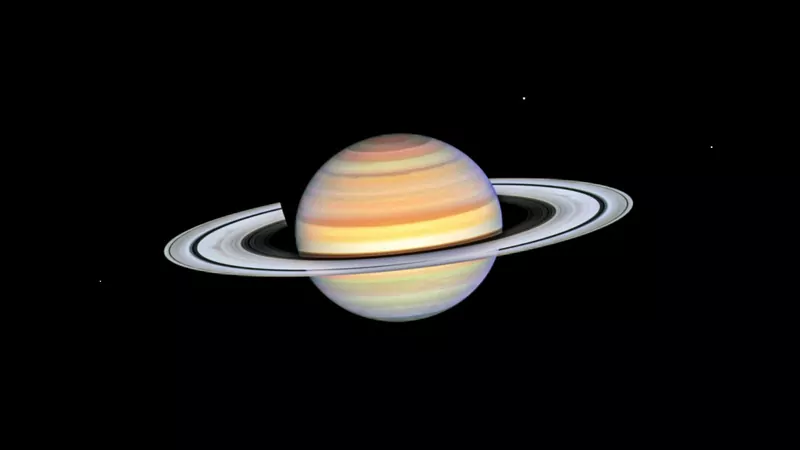
Not with the naked eye. A small telescope shows them clearly.
Where is Mars right now?
In the constellation Cancer, in the east-southeast before dawn, moving toward Jupiter.