Nobel Prize 2026: dates, times and who could win
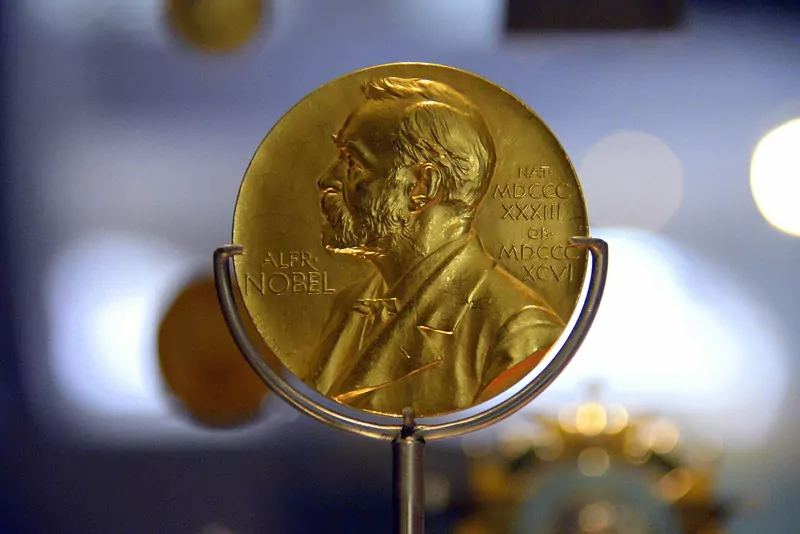
The 2026 Nobel Prizes will be announced on six days, from Monday 5 October to Monday 12 October. Each prize is worth 12 million Swedish kronor this year, about $1.21 million. That is up from 11 million in 2025, to mark the prize's 125th anniversary (Nobel Prize, AFP). When a prize has more than one winner, the money is shared.
Announcement schedule
These are the official times from the Nobel Foundation. Sweden and Norway are on summer time (CEST, UTC+2) that week. Every time is "at the earliest" except the Peace Prize, which has a fixed start.
| Prize | Day | Stockholm / Oslo | UTC |
|---|---|---|---|
| Physiology or Medicine | Mon 5 Oct | 11:30 | 09:30 |
| Physics | Tue 6 Oct | 11:45 | 09:45 |
| Chemistry | Wed 7 Oct | 11:45 | 09:45 |
| Literature | Thu 8 Oct | 13:00 | 11:00 |
| Peace | Fri 9 Oct | 11:00 | 09:00 |
| Economic Sciences | Mon 12 Oct | 11:45 | 09:45 |
In local time, the announcements fall between 5 and 7 a.m. in New York, 10 a.m. and noon in London and Lagos, noon and 2 p.m. in Cairo and Riyadh, 2 and 4 p.m. in Karachi, 2:30 and 4:30 p.m. in New Delhi, and 4 and 6 p.m. in Jakarta. Each one is streamed live on nobelprize.org and the Nobel Prize YouTube channel.
Who could win: the names being tipped
Nobody outside the prize committees knows who is on their shortlists, and nominations stay secret for 50 years. The names below are predictions by outside experts, not leaks.
For the science and economics prizes, the most-watched list comes from the data company Clarivate, which names "Citation Laureates" from the most-cited research. It says 89 of its picks have gone on to win a Nobel, often years later, and it does not claim to predict any single year. Its 2026 list includes:
- Medicine: Daniel Drucker, Jens Juul Holst and Svetlana Mojsov, for discovering and studying GLP-1, the hormone behind today's diabetes and weight-loss drugs. James Fujimoto, David Huang and Eric Swanson are also listed, for inventing the OCT eye scan.
- Physics: Chihaya Adachi, Stephen Forrest and Mark Thompson, for work that made OLED screens far more efficient.
- Chemistry: David Liu, for base editing and prime editing, two ways to make precise changes to DNA.
- Economics: Susan Athey and Hal Varian, for the economics of technology, and Michael Woodford, for monetary policy.
Literature has no data-based list, and the Swedish Academy's choice is famously hard to call.
The Peace Prize
The Norwegian Nobel Committee received 287 nominations this year, 208 people and 79 organisations (Reuters via Rappler). The leaders of Cambodia, Israel and Pakistan have said they nominated Donald Trump. The committee does not confirm names.
The Peace Research Institute Oslo publishes its director's own shortlist every year. The 2026 list, updated on 22 September, names:
- Mykola Kuleba of Save Ukraine, together with Save the Children, for protecting children in war
- Sudan's Emergency Response Rooms, volunteer groups that run community kitchens and aid in the war
- the Committee to Protect Journalists
- the International Court of Justice and the International Criminal Court
- the International Space Station partnership, as an example of rivals working together
Last year's winners
- Medicine: Mary Brunkow, Fred Ramsdell and Shimon Sakaguchi, for how the immune system is kept from attacking the body
- Physics: John Clarke, Michel Devoret and John Martinis, for quantum effects in an electric circuit
- Chemistry: Susumu Kitagawa, Richard Robson and Omar Yaghi, for metal-organic frameworks
- Literature: László Krasznahorkai
- Peace: María Corina Machado
- Economics: Joel Mokyr, Philippe Aghion and Peter Howitt, for explaining growth driven by innovation
Source: NobelPrize.org. We will add this year's winners to this page as they are announced.