India-NZ FTA Starts Oct 20: Tariffs, Visas, What Changes
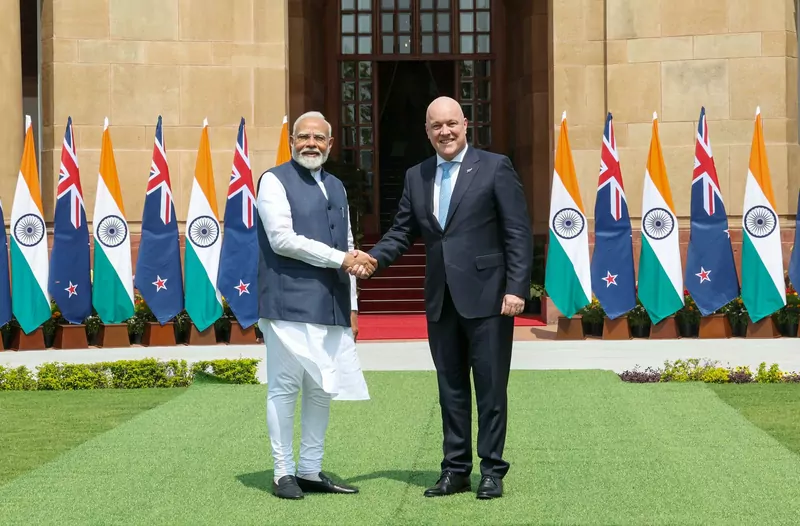
The India-New Zealand free trade agreement starts on Tuesday, October 20, 2026. On that day New Zealand removes its tariffs on all Indian goods, and India removes its tariffs on New Zealand wool, sheepmeat, coking coal and logs, among other products, according to New Zealand’s government and India’s Commerce Ministry. The visa changes for Indian students, skilled workers and young travellers do not start that day: the agreement gives New Zealand up to one year for the student commitments and up to two years for the working holiday scheme, and sets no date for the skilled-worker visas.
At a glance
| Item | Detail |
|---|---|
| Starts | Tuesday, October 20, 2026 (New Zealand MFAT; All India Radio quoting Commerce Minister Piyush Goyal) |
| Signed | April 27, 2026, in New Delhi (MFAT timeline) |
| Talks | Launched March 17, 2025; concluded December 22, 2025 (MFAT timeline) |
| Ratified | September 21, 2026: New Zealand’s trade minister Todd McClay and India’s High Commissioner exchanged the ratification documents in Parliament (New Zealand government, AAP) |
| Second tariff cut | January 1, 2027, for New Zealand exporters (AAP, quoting McClay) |
| Review | One year after the start (MFAT) |
| Trade today | NZ$3.9 billion two-way in the year to June 2026; India is New Zealand’s 9th-largest export market, at 1.8% of exports (MFAT) |
| Investment | New Zealand will promote US$20 billion of private investment into India over 15 years, and India will set up a New Zealand Investment Desk (MFAT) |
What changes on October 20
- Indian goods sold in New Zealand. New Zealand removes tariffs on 100% of its tariff lines (8,284 lines) for Indian goods, including about 450 lines that had tariffs of around 10%, among them textiles, clothing, leather, headgear, ceramics, carpets, cars and car parts. The average applied tariff of 2.2% goes to zero, India’s Commerce Ministry says (Ministry of Commerce, December 22, 2025). New Zealand’s trade ministry says this “should lower prices for Indian goods purchased by New Zealanders” (MFAT).
- New Zealand goods sold in India. 57% of New Zealand’s exports to India become tariff-free on the first day, including wool and coal, McClay said (AAP), rising to 82% over time, with sharp cuts on a further 13% (MFAT). The table below shows the main products.
- What India keeps out. India has offered cuts on 70.03% of its tariff lines and excluded 29.97%, including dairy (milk, cream, whey, yoghurt, cheese), sugar, onions, chana, peas, corn, almonds and gems and jewellery (Ministry of Commerce).
- Apple growers. India says the apple, kiwifruit and honey quotas come with a minimum import price and seasonal imports, so that farmers in India are protected (Ministry of Commerce).
New Zealand’s main exports to India
Exports are for the year to June 2026 (MFAT); the tariff figures are from New Zealand’s National Interest Analysis (NIA). New Zealand’s largest export to India is travel services (NZ$1.22 billion), which carries no tariff.
| New Zealand export to India | Exports, year to June 2026 | Indian tariff today and under the deal | When |
|---|---|---|---|
| Logs, wood pulp, most fibreboard, sawn wood | Forestry NZ$193 million | Duty-free. Almost all other forestry trade is phased out over seven years. | Oct 20, 2026 |
| Wool | NZ$84 million | 2.75% to zero | Oct 20, 2026 |
| Sheepmeat | Not in MFAT’s list | 33% to zero | Oct 20, 2026 |
| Coking coal | Not in MFAT’s list | 2.75% to zero | Oct 20, 2026 |
| Apples | NZ$100 million | 50% to 25% within a quota of 32,500 tonnes a year, rising to 45,000 tonnes by year six | Oct 20, 2026 |
| Kiwifruit | NZ$28 million | Duty-free for 6,250 tonnes a year, rising to 15,000 tonnes by year six; outside the quota the 33.5% tariff is halved to 16.5% | Oct 20, 2026 |
| Iron and steel | NZ$84 million | Tariffs of up to 22% removed over up to 10 years | Phased |
| Fish and seafood, infant formula | Not in MFAT’s list | 33% removed over seven years | Phased |
| Cherries, avocados, blueberries, persimmons | Not in MFAT’s list | 33% removed over 10 years | Phased |
What does not start on October 20
New Zealand needs new immigration instructions to put its visa promises into practice, and it will charge a fee for the new visa categories (National Interest Analysis). No visa category can open before the agreement starts, and we found no Immigration New Zealand announcement of start dates as of October 15. The agreement sets outer deadlines for two of the three.
| Change | What the agreement says | When it must start |
|---|---|---|
| Indian students in New Zealand | Work at least 20 hours a week, in line with New Zealand’s student visa policy, and no cap on admissions. After study, stay and work up to 2 years after a bachelor’s degree, 3 after a master’s, 4 after a doctorate, and 3 for a first-class honours bachelor’s in STEM fields (Annex 8F) | Within one year of the start, so by October 2027 |
| Skilled workers (temporary employment entry visas) | Up to 5,000 visa holders in New Zealand at any one time, for three years each: 4,400 in skill-shortage jobs and 600 in “iconic” Indian jobs such as yoga instructors and chefs. A genuine job offer from an accredited New Zealand employer is required, and software engineers and programmers need a degree and five years’ experience (New Zealand’s National Interest Analysis, Annex 8L) | No date set. New Zealand must write new immigration instructions and set a fee |
| Working holiday visa for young Indians | Up to 1,000 a year, for 12 months, for Indian citizens aged 18 to 30 with at least three years of tertiary study, functional English and no dependants; work is incidental to the holiday (side letter) | Within two years of the start, so by October 2028 |
Partners of the skilled-worker visa holders are not intended to get work rights, and dependent children are not intended to get domestic student status, New Zealand says (National Interest Analysis). India’s Commerce Ministry says around 300,000 people of Indian origin and Indian citizens live in New Zealand, nearly 5% of the population.
The timeline
| Date | What happens |
|---|---|
| Mon, Mar 17, 2025 | Both governments announce the start of negotiations; Narendra Modi and Christopher Luxon meet in New Delhi |
| Mon, Dec 22, 2025 | Negotiations concluded |
| Mon, Apr 27, 2026 | Agreement signed in New Delhi |
| Mon, Sep 21, 2026 | Ratification documents exchanged in New Zealand’s Parliament |
| Tue, Oct 20, 2026 | Agreement starts; New Zealand removes tariffs on all Indian goods; India’s first tariff cuts take effect |
| Fri, Jan 1, 2027 | Second round of tariff cuts for New Zealand exporters |
| Oct 2027 | One-year review, and the deadline for the student and post-study commitments |
| Oct 2028 | Deadline for New Zealand to open the working holiday arrangement |
What we do not know yet
- Visa start dates and fees. We found no Immigration New Zealand announcement of when the skilled-worker or working holiday visas open, or what they will cost.
- How exporters claim the tariff cut. The agreement’s text has the rules of origin and the tariff schedules (full text). MFAT says approved New Zealand exporters can declare origin themselves from the start.
Sources
- New Zealand Ministry of Foreign Affairs and Trade: NZ-India FTA page, key outcomes, key facts, timeline, agreement text, National Interest Analysis
- New Zealand government: New Zealand and India ratify free trade agreement (September 21)
- India: Ministry of Commerce and Industry summary (December 22, 2025); All India Radio (September 21)
- AAP, September 21, on the October 20 start and the January 1, 2027 cut