Ada Lovelace Day 2026: Date, Who She Was and Ideas
Ada Lovelace Day is on Tuesday, October 13, 2026. It always falls on the second Tuesday of October. The day celebrates women in science, technology, engineering and maths (STEM), and it is named after Ada Lovelace, the 19th-century mathematician whose notes on a never-built machine are often called the first published computer program.
| Year | Ada Lovelace Day |
|---|---|
| 2026 | Tuesday, October 13 |
| 2027 | Tuesday, October 12 |
| 2028 | Tuesday, October 10 |
| 2029 | Tuesday, October 9 |
How the day started
Suw Charman-Anderson started Ada Lovelace Day in the UK in 2009 as a "day of blogging": she asked people to write about a woman in STEM they admired. The first one was held on March 24, 2009; the day later moved to October, and it now falls on the second Tuesday of the month (I Programmer). It grew into an international day, with events run by museums, universities, schools and professional societies. Many of them spread across October and November (Wikipedia).
In 2022 Charman-Anderson said that would be the last year her organisation, Finding Ada, would run its flagship event in England (BBC). The Royal Institution in London then stepped in and hosted Ada Lovelace Day Live in 2023. The day itself carries on, with schools, universities and groups around the world holding their own events.
Who was Ada Lovelace?
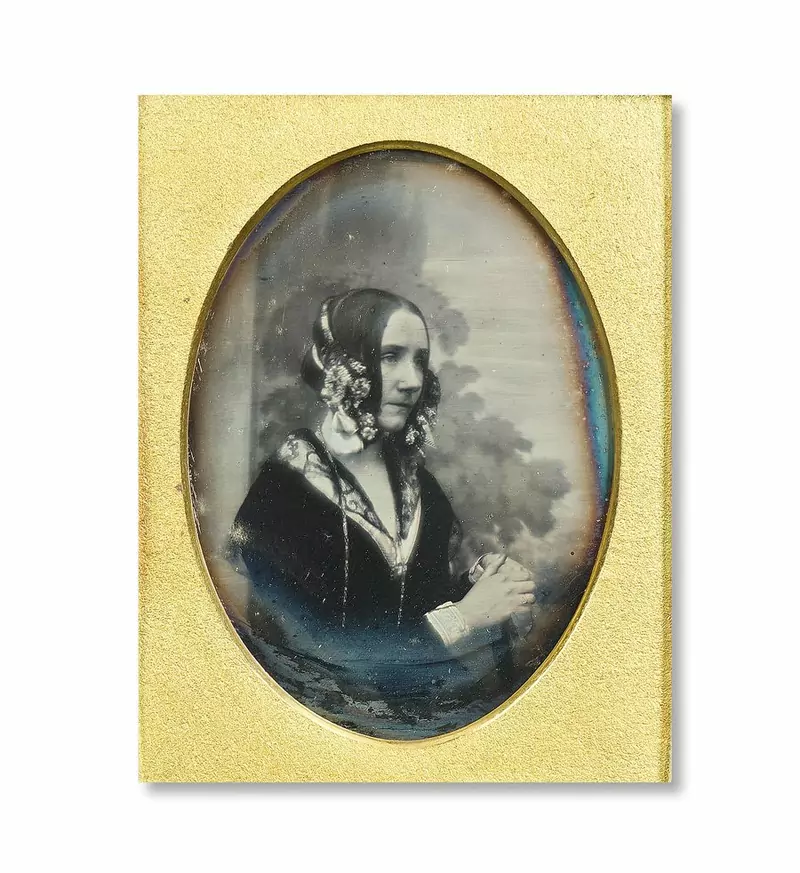
- Born Augusta Ada Byron on December 10, 1815, in London. She died on November 27, 1852, aged 36.
- Family: she was the only legitimate child of the poet Lord Byron and Anne Isabella Milbanke. Her parents separated weeks after she was born, and her mother had her taught mathematics and science from an early age.
- Teachers: among them were the science writer Mary Somerville and, later, the mathematician Augustus De Morgan, who helped her with the Bernoulli numbers she later used in Note G.
- Babbage: she met the inventor Charles Babbage through Mary Somerville in June 1833, at 17, and became fascinated by his calculating machines. He called her "the Enchantress of Number".
Facts from the Wikipedia biography and its sources.
What she actually did
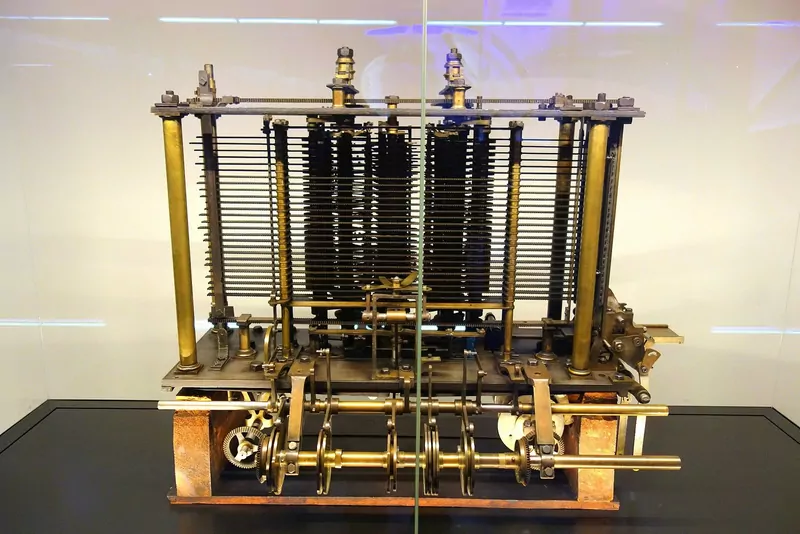
Babbage designed the Analytical Engine, a mechanical general-purpose computer that would read instructions from punched cards. It was never finished. In 1842 the Italian engineer Luigi Menabrea wrote an article about it in French. Lovelace translated it into English and added seven notes, labelled A to G, that ended up about three times as long as the article. They were published in September 1843, signed only with her initials, A.A.L.
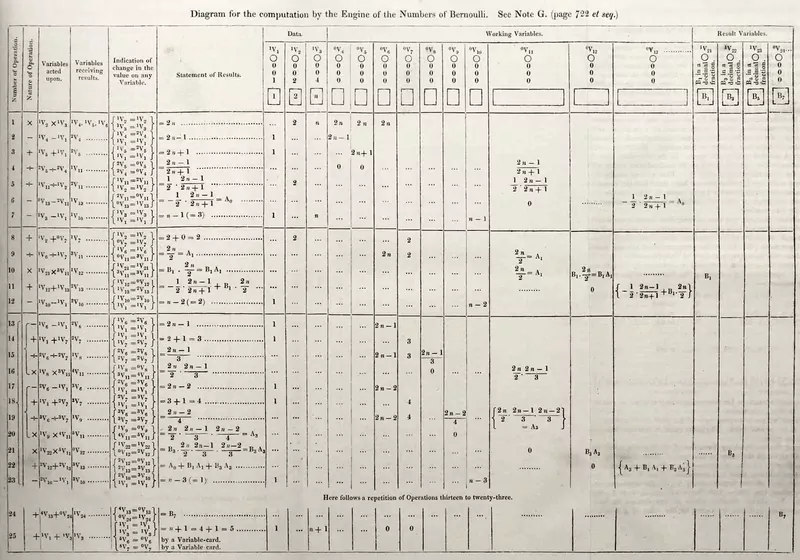
- Note G sets out, step by step, how the Engine could calculate a sequence of Bernoulli numbers. Her table of operations is often called the first published computer program.
- The bigger idea: she saw that the machine could work on more than numbers. If music could be written as symbols, she wrote, the Engine "might compose elaborate and scientific pieces of music of any degree of complexity or extent."
- The debate: Babbage had written several dozen sample programs for the Engine between 1837 and 1840, though most were never published, and he later claimed credit for the Note G method. Historians such as Doron Swade credit her with a different leap: seeing that a machine that handles numbers could handle any symbols the numbers stand for, like letters or musical notes.
Her name lives on in computing. The US Department of Defense named its programming language Ada after her; its military standard, MIL-STD-1815, uses the year she was born (Wikipedia).
10 ways to mark Ada Lovelace Day
- Do what the day started with: post about one woman in STEM you admire and what she did, with #AdaLovelaceDay.
- Pick someone less famous. A teacher, a lab technician, an engineer at your company. The day was made for people who don't get credit.
- Join or run a Wikipedia edit-a-thon. Many Ada Lovelace Day events write or improve articles about women scientists who don't have one yet.
- Read Note G yourself. Her notes are short, and seeing the 1843 table makes "first program" feel real.
- Try an "unplugged" algorithm in class. Have students write step-by-step instructions for a simple task, like Lovelace did for the Engine, then swap and follow each other's steps exactly.
- Learn one line of code. Any free beginner course will do. It's a fitting way to spend her day.
- Visit a science museum. In London, the Science Museum holds Babbage's trial model of part of the Analytical Engine (the photo at the top).
- Invite a speaker. Ask a woman working in STEM to talk to a class or team for 15 minutes about her job.
- Make a "who did this?" quiz. Show inventions and discoveries and ask who was behind them. Use the list below.
- Check your reading list. Add one book about a woman in science to your list for the month.
8 women in STEM to share on the day
- Mary Somerville: Scottish scientist and science writer, Ada Lovelace's tutor, and the friend through whom she met Babbage.
- Marie Curie: the first person to win two Nobel Prizes, in physics (1903) and chemistry (1911).
- Grace Hopper: US Navy rear admiral and computer pioneer who built one of the first compilers and helped shape the COBOL language.
- Katherine Johnson: NASA mathematician who checked the orbit calculations for John Glenn's 1962 flight and worked on Apollo.
- Rosalind Franklin: chemist whose X-ray images of DNA, including Photo 51, were key to finding its double-helix structure.
- Margaret Hamilton: led the team that wrote the onboard flight software for the Apollo Moon missions.
- Tu Youyou: Chinese scientist who discovered artemisinin, now a key part of malaria treatment worldwide; Nobel Prize in 2015.
- Maryam Mirzakhani: Iranian mathematician and, in 2014, the first woman to win the Fields Medal.
Quick answers
When is Ada Lovelace Day 2026?
Tuesday, October 13, 2026, the second Tuesday of October.
Why is it in October if she was born in December?
The date isn't tied to her life. The first Ada Lovelace Day was in March 2009; it later moved to October, and the second Tuesday of October is now its fixed date each year.
Is Ada Lovelace Day a public holiday?
No. Schools, offices and shops are open as normal. It's an awareness day marked by events, lessons and posts.
Was Ada Lovelace really the first programmer?
Her Note G, published in 1843, is the first computer program ever published. But Babbage had written sample programs for the same machine a few years earlier, most of them never published. So she is fairly called the author of the first published program; whether she was the very first programmer is still debated.
What hashtag do people use?
#AdaLovelaceDay, often with #WomenInSTEM.