BC Election Results: Conservative Majority 2026
The BC Conservatives won a majority government in the October 24, 2026 election, taking 64 of the 93 seats; the NDP fell to 27 and David Eby resigned as party leader on election night. Interim leader Lorne Doerkson is the new premier — the first time a party led by an interim leader has won an election in Canadian history. Final results were returned by Elections BC on November 18, with turnout at 52% (Wikipedia, citing Elections BC).
The results
| Party | Leader | Seats (of 93) | Popular vote | Vote share |
|---|---|---|---|---|
| Conservative | Lorne Doerkson (interim) — now premier | 64 | 928,019 | 49.5% |
| New Democratic (NDP) | David Eby (resigned as leader) | 27 | 730,939 | 39.0% |
| Green | Emily Lowan (newly elected MLA) | 2 | 216,808 | 11.6% |
CentreBC and OneBC lost all their seats, with leaders Elenore Sturko and Dallas Brodie defeated by wide margins. Vote shares are our calculation from Elections BC's counts.
Key dates
| When | What |
|---|---|
| Oct 13 and 14 | Leaders' debates (Greater Vancouver Board of Trade on the 13th; TV debate on CBC, CTV, Citytv, Global BC and CHEK on the 14th) |
| Sat, Oct 17 | B.C. municipal elections (a separate vote for mayors and councils) |
| Oct 16–21 | Advance voting, 8 a.m. to 8 p.m. local time, at any advance voting place |
| Sat, Oct 24 | Final Voting Day, 8 a.m. to 8 p.m. Pacific Time, at your assigned voting place |
| Nov 6–10 | Final count, including absentee and mail-in ballots |
| Nov 18 | Final results returned |
Sources: Elections BC, and the Wikipedia election page for the debate and final-count dates. Polls close at 8 p.m. Pacific, which is 9 p.m. in Calgary, 11 p.m. in Toronto and 03:00 UTC on October 25.
How to vote
- Who can vote: Canadian citizens who are 18 or older on October 24, 2026 and have lived in B.C. since April 23, 2026 (Elections BC).
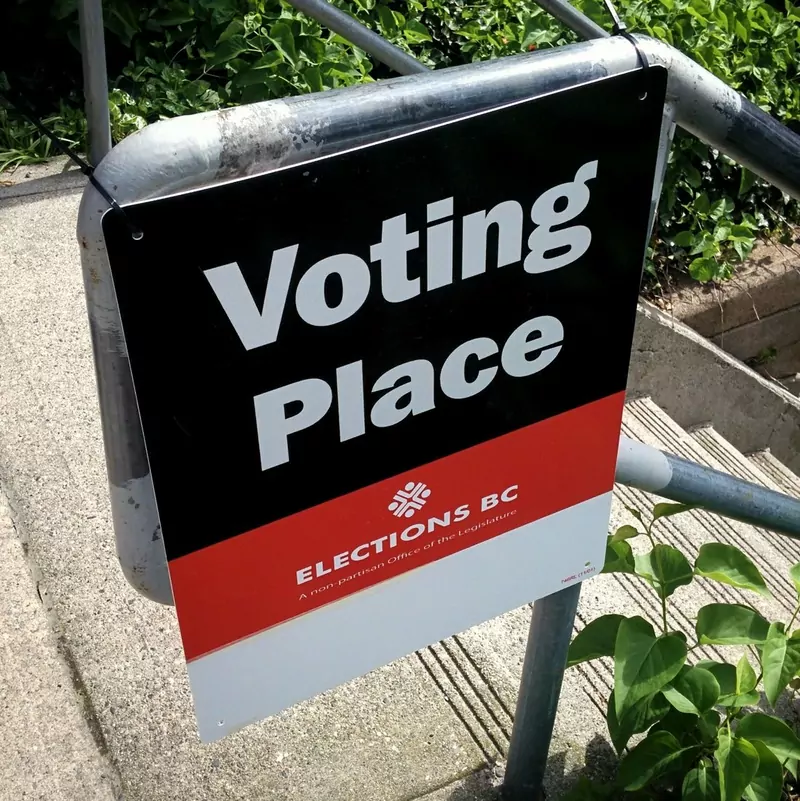
- Where: on October 24, at the voting place assigned to you on your Where to Vote card. During advance voting, at any advance voting place. You can also vote at a district electoral office until 4 p.m. on October 24, or by mail if you request a package in time.
- ID, option 1: one piece of ID such as a B.C. driver's licence, a BCID card, a BC Services Card with photo, or another government card with your name, photo and address.
- ID, option 2: two documents that both show your name, at least one with your current address, such as a passport, a bank statement, a property tax assessment or a student card.
- ID, option 3: if you have no ID, someone can vouch for you, but only a registered voter who lives in your electoral district; your spouse, parent, grandparent, adult child, adult grandchild or adult sibling; or a person with authority to make personal care decisions for you. The voucher must show their own ID (Elections BC voter ID).
The parties and leaders
| Party | Leader | Seats at dissolution | Candidates |
|---|---|---|---|
| New Democratic (NDP) | David Eby, premier | 47 | 92 |
| Conservative | Lorne Doerkson (interim) | 28 | 93 |
| CentreBC | Elenore Sturko | 8 | 35 |
| Green | Emily Lowan | 2 | 74 |
| OneBC | Dallas Brodie (interim) | 2 | 34 |
Seat counts at dissolution and candidate numbers are from the Wikipedia election page. Several MLAs moved between caucuses after the election call, and most of CentreBC's MLAs rejoined the Conservatives. The NDP is not running a candidate in Peace River North, where its nomination paperwork was incomplete.
Why there's an election now
The last election, in October 2024, gave the NDP a narrow majority of 47 of the 93 seats. B.C.'s fixed-date law would have put the next one in October 2028, but the premier can ask for an early dissolution. Eby called it on September 22, framing the campaign around the trade war with the United States. It came two days after Conservative leader Kerry-Lynne Findlay resigned following months of departures from her caucus, and critics, including municipal leaders who had asked him to avoid the overlap with local elections, said the timing was opportunistic (The Canadian Press via Narcity).
What the polls say
Polls are snapshots, not predictions. Every poll with fieldwork in October has shown the Conservatives ahead of the NDP, by 2 to 8 points, including the latest, by Angus Reid after the October 14 leaders' debate:
| Pollster, dates | NDP | Con. | Green |
|---|---|---|---|
| Angus Reid, Oct 15–19 | 43% | 46% | 8% |
| Pollara, Oct 8–13 | 36% | 41% | 13% |
| Leger, Oct 9–12 | 40% | 42% | 9% |
| Pallas Data, Oct 10–11 | 38% | 43% | 11% |
| Research Co., Oct 9–11 | 42% | 44% | 8% |
| Ipsos, Oct 7–11 | 38% | 43% | 11% |
| Liaison, Oct 7–8 | 37% | 43% | 10% |
| Mainstreet, Sep 30–Oct 1 | 37% | 45% | 11% |
| Innovative, Sep 25–28 | 41% | 39% | 11% |
The table shows each pollster's latest poll since the election was called on September 22. Figures from the polling table on the Wikipedia election page, which links each poll.
When the results come
Counting starts when the polls close at 8 p.m. Pacific on October 24. In 2024 Elections BC used vote-counting machines and projected that 98% of votes would be reported within an hour of polls closing, apart from late mail-in ballots and close races sent to recounts. Close seats can wait for the final count from November 6 to 10, when the remaining mail-in and absentee ballots are added. In 2024 that final count flipped Surrey-Guildford from the Conservatives to the NDP and decided the majority, nine days after election day (Wikipedia).
Quick answers
When is the BC election?
Saturday, October 24, 2026. Advance voting ends on Wednesday, October 21.
What time do polls close in BC?
8 p.m. Pacific Time on October 24. They open at 8 a.m.
Is this the same as the municipal election?
No. B.C.'s municipal elections, for mayors, councils and school boards, were on October 17 (see the Vancouver results). The provincial election, for MLAs, is a week later.
How many seats are needed for a majority?
47 of the 93 seats.
Can I vote if I just moved to B.C.?
Only if you've lived in B.C. since April 23, 2026, are a Canadian citizen and are 18 or older on election day.